Posts

Showing posts with the label openstack

SSH as service - more use cases
Image
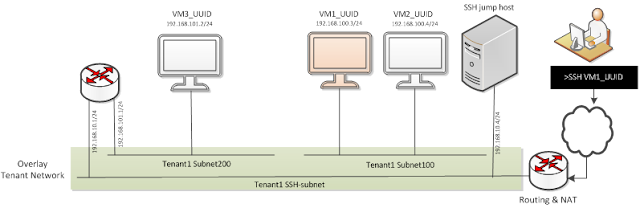
In previous post  I described the most straightforward use case of SSH service usage: access VM at routable tenant private network. The more interesting case could be to access a VM1_UUID that lays on not routable network: Tenant1 Subnet100 figure 1 Achieving SSH connectivity requires SSH gate (SSH jump host) to have a network interface on Tenant1 Subnet100. SSH service have to allocate neutron port on Tenant1 Subnet100 network and attach new port to SSH gate. Dynamic port attachment requires some underground SSH gate network configuration. SSH Service daemon can access SSH gate VM with SSH management key and update network configuration. figure 2 Now traffic may flow to VM1_UUID even without router involvement. Authentication is performed gradually. We may use same concept of SSH configuration file with proxy command.  figure 3 Generic SSH service Both routable and no routeable VM connection schemes lays on boundary of specific tenant. The more gen...

SSH as a service

Image
This post starts a series of posts devoted to newly created SSH cloud service Motivation for SSH service SSH was and remains a handy tool for all network administrators. At cloud deployment w e need a way to remotely SSH a VM in the cloud that is not connected to the internet from outside of the cloud. Such task requires VPN. Among disadvantages of VPN I can mention:   VPN does not support internal, non-routable networks  VPN is less secured since it allows access to all devices on all routable networks in the cloud  Requires a special client   Error-prone – client might set the VPN server as its default GW which will direct all its outgoing traffic to the cloud Tenant administrator wants to setup service that will handle network connectivity, hide address details from outside user and at the same time save cloud floating IP addresses from being attached/detached according to current tenant users immediate request. User  wa...

Distributed SNAT - examining alternatives

Image
SNAT feature remains one of the most common network features in cloud network deployment that still has no agreed distributed solution. While Distrubuted Virtual router solves local connectivity for floating IP and simplifies east-west VM communication SNAT is still deployed at Network node and remains a traffic bottleneck. figure 1 Above figure has 2 deployed tenants 'green' and 'orange'. SNAT is performed centrally at network node. Possible solutions The are number of proposed solution to decentralize SNAT. Each solution has its own benefits and drawbacks. 1. SNAT per (tenant, router) pair The most straightforward solution is to perform SNAT at compute node router instance.  However while DVR deployment is copying internal subnet router address across compute nodes router's IP address on external network can not be copied. Such a deployment will consume extra external address per (router, tenant) pair. figure 2 Maximum address consumption...